



NEWSLETTER | PODCAST | NEW MEDIA

Hey readers!
Welcome back to your regular tech digest — a quick snapshot of the most important recent tech news worth paying attention to.
This week has been a chaotic one: public markets were rattled while private markets stayed active. Nvidia announced a $5 billion investment in Safe Superintelligence, DoorDash launched its in-house drone delivery service, Highland Europe closed a €1.1 billion growth fund, and Cyera agreed to acquire Oasis Security in a $1 billion deal.
This edition covers:
🗝️ Trend of the week: The Death of the Keyboard
🔍 Top startup tech news
💰 Startup funding highlights easily sourced by using Harmonic
🤝 Acquisitions
👀 New VC funds launched
🎤 Must-watch interviews from our podcast show
and much more.
A message from today’s partner: Mostly Metrics
The CFOs of Robinhood, Figma, Plaid, and Major League Baseball all read the same free newsletter every week.
Mostly Metrics is trusted by 75,000 readers which regularly breaks down metrics and monetization models the best CFOs in the world actually use to run their companies. Fundraising. Headcount planning. Pricing. The stuff nobody teaches you until you’re already in the seat.
Subscribe to the Mostly Metrics newsletter to learn the latest strategies.
🗝️ Trend of the week: The Death of the Keyboard
Tanay Kothari, founder of Wispr Flow, joined NEW ECONOMIES to explain why he believes voice could become the default way people interact with computers.
His starting point is accessibility. Around 700 million people worldwide have dyslexia or a speech impediment, making typing far more difficult than speaking. But Wispr Flow’s growth, 30× year over year and 15,000 enterprise customers, including more than half of the Fortune 500, suggests that voice isn’t just solving an accessibility problem. It’s becoming a faster, lower-friction way for many people to work.
Tanay argues that as voice interfaces improve, keyboards will increasingly be reserved for tasks that require precision, like editing or coding, much like film cameras are still used by enthusiasts, even though digital photography became the default for most people.

Getting people to believe in voice, however, was a bigger challenge than making it accurate. After years of disappointing experiences with assistants like Siri, users were skeptical. Wispr’s breakthrough was making voice input quiet and reliable enough to use in shared workspaces. Features like Talk & Whisper let teams at companies such as Ramp and Klarna dictate naturally at their desks, making voice practical in everyday office environments.
If this trend continues, the biggest barrier to voice may no longer be the technology, but habit. Just as touchscreens replaced physical keyboards on smartphones, speaking to your computer could become the default interface for everyday work, leaving the keyboard as a specialist tool for moments when precision matters most.
What do you think?
From the NEW ECONOMIES archive: The Future of Voice
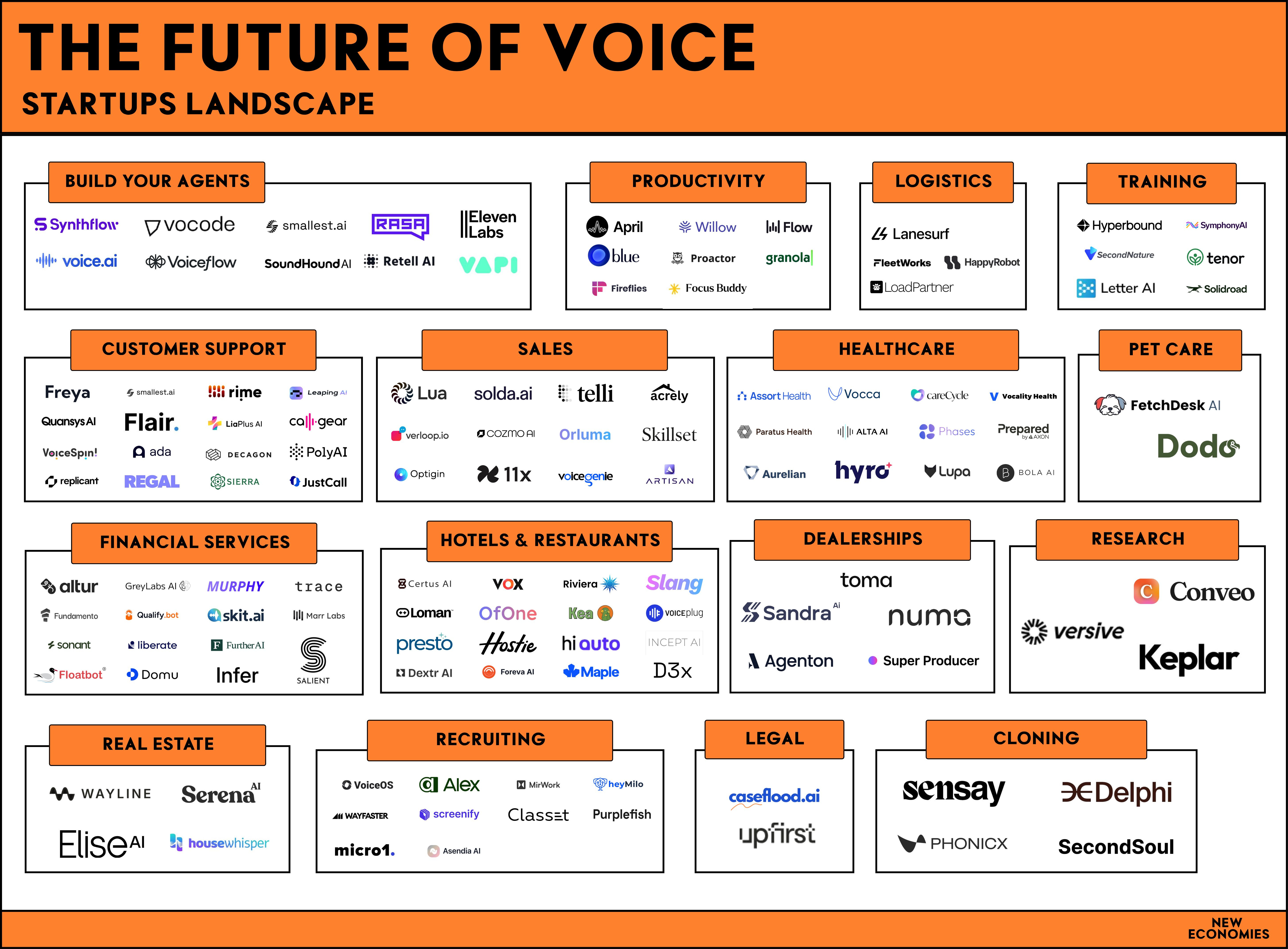
🔍 Top startup tech news
AI chip stocks lost $1.3T in market cap as Nvidia, TSMC, and Samsung got hammered by growing fears over whether the massive AI infrastructure buildout will deliver real returns, the sharpest correction in the AI trade since the boom began.
DoorDash launched DoorDash Air, its in-house drone delivery service.
Nvidia is set to invest $5B in AI startup Safe Superintelligence, marking one of the chipmaker’s largest direct bets on an AI company.
💰 Startup funding highlights
Antares raised $470M to build nuclear reactors for the US military.
Harmony raised $34M in Seed funding led by Lightspeed to automate workplace requests.
Pangram raised $9M led by Menlo Ventures to detect AI generated content.
Spur Intelligence raised $200M led by Insight Partners to help identify fake users and threats.
Henry AI raised $16.5M Series A led by FirstMark to automate back-office document workflows for commercial real estate teams.
Throne raised $10M Series A led by Will Ventures to build an AI-powered toilet sensor that tracks gut health and works toward early colon cancer detection.
ThreatLocker raised $190M Series F led by Elephant to scale its Zero Trust cybersecurity platform, now protecting over 70,000 organizations worldwide with deny-by-default endpoint security.
Glow raised $180M Series A led by Sequoia and Cyberstarts to build AI-powered endpoint security for the agentic era, emerging from stealth as a unicorn at a $1.2B valuation.
Freehand raised $75M Series B co-led by Battery Ventures and NewRoad Capital to run supply-chain spend for Fortune 500s with autonomous AI agents, already deployed at Meta, Unilever, J&J, Pfizer, and Dunkin.
ProphetX raised $35M to expand its regulated sports prediction market platform.
Twenty raised $30M led by Khosla Ventures to build AI-enabled cyber warfare and defense systems for military and intelligence agencies.
Trooly raised $20M Seed to automate qualitative user research with AI agents that conduct deep 45-minute interviews across 180M respondents in 25 countries.
Centralize raised $19M led by NEA to build relationship intelligence for enterprise sales teams.
Healia raised $18M including a $14M Series A to reduce health benefit costs for dual-income families and employers.
Sourced by using Harmonic
🤝 Acquisitions
Cyera agrees to acquire Oasis Security for $1B to safeguard proliferating AI agents.
Legora acquired Wexler to add AI-powered litigation and fact analysis to its legal AI workflows, Legora’s fifth acquisition since its March 2026 Series D.
Midjourney acquired the astrology app Co-Star.
Sony offers to acquire Tamron.
👀 New VC funds launched
Highland Europe raised €1.1 Billion Fund VI to back growth-stage European technology companies.
Index Ventures raised $3.5B in fresh funds.
🎤 Must-watch interviews from our podcast show
Cameron Adams, co-founder and Chief Product Officer at Canva, joins NEW ECONOMIES to explain why AI gives creators more options than ever but not more chances to send the right message, and why taste becomes the real opportunity once every tool produces passable designs.
Previous episodes include
Hollywood is Secretly Replacing Films With AI | Justine Moore.
Why most people are underusing AI and why the winners won’t just be OpenAI and Anthropic | Reid Hoffman.
Base44 Founder: The Strategy Behind Building a Million Dollar Company Solo | Maor Shlomo (Base44) & Mark Tluszcz (Wix).
AI is a Better Writer Than You But Here’s What it Can’t Replace | Mark Manson.
The Couple That Bootstrapped a Billion Dollar Company | Julia & Kevin Hartz.
Email Never Died | Rahul Vohra founder at Superhuman.
Replit’s President & Head of AI | Michele Catasta.
Inside Mercury’s Founding Story | Co-Founder & CEO Immad Akhund.
Inside Gusto’s Founding Story | Co-Founder & CTO Eddie Kim.
We Had to Reimagine Nextdoor | CEO & Co-Founder Nirav Tolia.
5 Grand Slam Champion Maria Sharapova: Tennis Icon | Entrepreneur | Investor | New Media Creator.
Watch and subscribe now!

NEW ECONOMIES Subscriber Offers
Hyperagent: Build AI agents super easily. Get $1,000 in free credits here. Enter code NEWECONOMIES.
Hostinger: Buy a domain, hosting service or build any website within minutes. Start building with 10% off here.
Attio: Tired of trying multiple CRM tools? Attio is the favorite, used by thousands of startups. Start using it here.
Harmonic is your go-to startup database provider.
If you enjoyed this edition, help sustain our work by clicking ❤️ and 🔄 at the top of this post.
The pattern I see with my clients: voice interfaces could help older Indian professionals who struggle with typing, but habit and privacy in shared spaces remain barriers.
Until voice is reliable in noisy Indian offices and respects local languages, the keyboard stays.
Still, for financial planning check-ins, voice could be a game-changer for accessibility.