Fireflies AI
How Krish Ramineni built a profitable AI unicorn without spending a dollar on marketing, and why he thinks there will be 5,000 losers for every five AI winners.


Subscribe to stay ahead of technology trends. Never miss future editions.

Fireflies.ai founder Krish Ramineni built a profitable AI unicorn without spending a dollar on marketing
Right now, AI startups are racing to raise bigger rounds at higher valuations, often before they have a real revenue stream. Our latest guest thinks a lot of them won’t survive it. As he puts it:
“For every five winners, there’s going to be 5,000 losers.”
Meet Krish Ramineni, co-founder and CEO of Fireflies.ai. He joined us to explain why Silicon Valley hype is broken, why “it’s never been easier to build a startup, but it’s never been harder to stand out,” and why he thinks a single-use-case AI product won’t last long.
You might not know this, but Krish was one of the youngest product managers in Microsoft’s history, working on the first growth team for Microsoft Office. He left after a year to start Fireflies in 2016 with his co-founder and CTO, Sam Udotong. Back then, the AI notetaker category didn’t exist. Today, Fireflies serves more than 20 million people at over 500,000 organisations, including teams at 75% of the Fortune 500.
Unlike many Silicon Valley startups, Fireflies hasn’t raised a funding round since 2021 and has been profitable since 2023. In June 2025, a tender offer for employee shares valued the company at $1 billion, despite it raising only $19M in its history. The founders model the company on Costco: skip the marketing, and put the money into value for members instead.
In our episode, we learn:
Why distribution is AI’s hardest problem. Every growth channel gets saturated eventually, from product-led viral loops to Meta and TikTok ads to paid creator deals. Krish explains why viral moments keep getting shorter, why building in public can backfire, and why the next AI winners will be the ones with the best distribution
Why the AI bubble will hurt. AI is real, but the economics around it aren’t there yet. Krish explains why he doesn’t trust “annualised revenue” figures, why founders taking money off the table through secondaries worries him, and why he thinks there are “no moats in software”
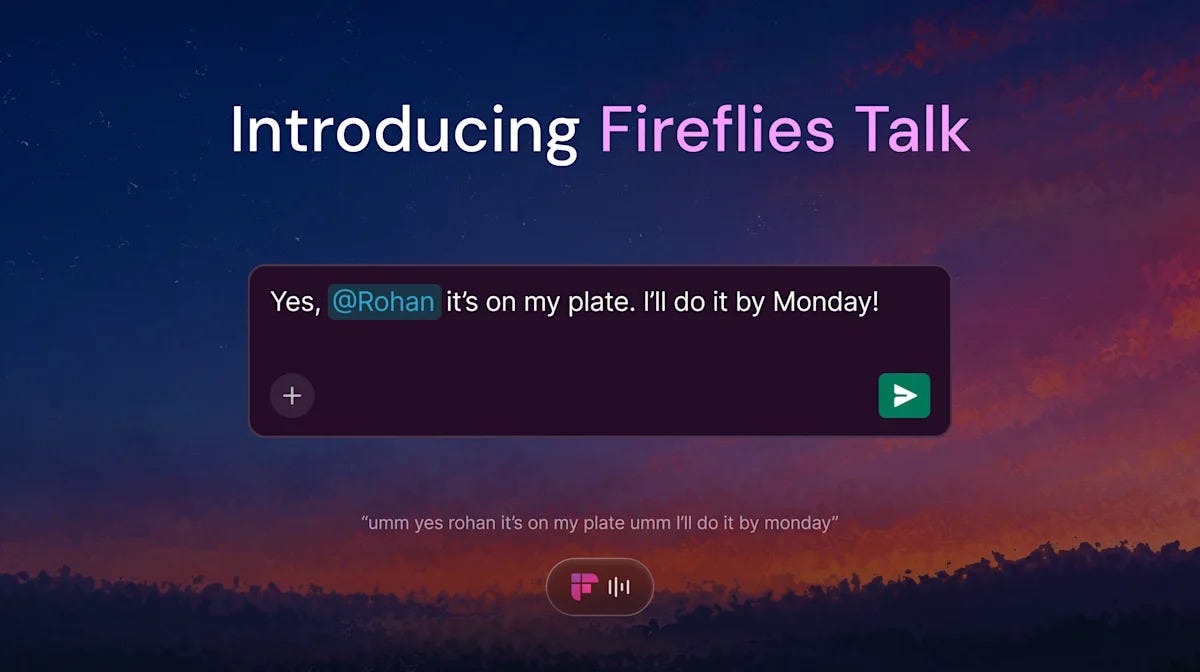
How Fireflies grew from notetaker to AI teammate. Fred, Fireflies’ AI assistant, now handles email, Slack and the CRM, and Fireflies Talk, the company’s dictation tool, is free. Krish explains why he believes a dictation tool alone is “one Apple or Google update away from being irrelevant,” and how his team built Fireflies Talk in two months with only a few engineers
Why Fireflies is getting into hardware. The first device is Fireflies Fly, which snaps onto the back of your phone and captures phone and WhatsApp calls. Krish explains why iOS and Android left him no other option, and why he would rather sell the device at a steep discount than live off one-off hardware sales
Why the future belongs to small teams. Krish sees companies made up of two- and three-person pods, staff who can work across functions, and individual contributors who manage agents. He also explains why middle management is more exposed to AI than entry-level roles, why you don’t need to be in San Francisco to build, and why his ideal customer is a 60-year-old running a farm
Watch or listen now across YouTube, Apple Podcasts, Spotify, and X
Download the transcript 👇

Timestamps
(0:00) Meet Krish Ramineni
(2:15) The state of AI note-takers
(4:47) Preparing for model disruption
(8:26) Distribution is king, and hard
(16:28) Will hyped startups disappear?
(18:32) The next wave of AI companies
(23:41) Should startups share their numbers?
(26:52) Why Fireflies stopped raising
(31:35) The Fireflies bundle
(34:04) The hardware opportunity
(40:37) Why dictation is hyped
(43:40) Tools Fireflies shut down
(46:48) Will digital twins attend meetings?
(49:37) AI will improve middle management
(51:57) How roles change in 12 months
(57:13) Opportunities outside SF
(1:02:08) Fireflies has news!
Inside Fireflies, Krish Ramineni’s Profitable $1B Bet Against AI Hype


Why the AI Bubble Will Hurt
Krish is no AI sceptic. He is sceptical about the money around it.
“AI is real. It works. But the valuations that are put on AI, the economics around AI is not as good as it needs to be.”

He compares the moment to the dot-com bubble. Everyone thought web startups were a scam, and yet eBay, Amazon and Netflix came out of it. AI will produce real companies too, but “for every five winners, there’s going to be 5,000 losers.” Right now, he says, everyone is raising as if they are the winner.
Two things worry him. Founders are taking tens of millions of dollars off the table through secondaries every round, even when the company doesn’t need the capital. And headline revenue numbers have changed meaning. Annual recurring revenue used to mean real subscriptions. Now companies quote “annualised revenue” from a single peak month of usage. When he hears one, his questions are simple: what is your churn, what is your retention, and what happens when the bigger players arrive?
“I almost feel like it’s a vanity metric how much money these companies are raising.”
Distribution Is the Hardest Part
Building has never been cheaper. Getting noticed has never been harder.
“It’s never been easier to build a startup, but it’s never been harder to stand out among the crowd.”
Krish describes how every growth channel eventually gets saturated:
The viral loop: seeing a Fireflies bot in a meeting was once novel enough to drive growth on its own. It still works, but less well over time.
Paid ads: venture-backed companies pour money into Google, Meta and TikTok ads while the arbitrage lasts, until everyone else does too.
Creators: startups now pay influencers to make ads that look organic, and the influencers have realised they can charge a lot more, whether a post performs or not.
The windows of attention are shrinking too. Companies go viral for a few weeks and then disappear. Building in public can backfire, he warns: your business may not be growing, but now your competitors know exactly what you are doing.
The Costco Playbook
Krish’s answer to all of this comes from outside tech.
“What Costco says is we’re not going to do marketing. We’re going to do whatever it takes to make our members happy.”

Instead of spending on billboards, Fireflies puts the money back into the product. He tells the story of a rival in his market that burned millions on billboards and bus posters placed wherever VCs were in New York and San Francisco, purely to raise its next round. Fireflies went the other way: win on price, win on quality, and let customers do the talking.
From Notetaker to AI Teammate
Krish believes single-purpose AI products won’t last.
“A single use case product will not have a long shelf life. You have to evolve into something that serves as a suite or serves problems end to end.”
Most of the expansion came from customers. They asked for a desktop app so they could take notes without a bot, then a mobile app for in-person meetings, then an email assistant. Fred, Fireflies’ AI assistant, now drafts emails, sorts inboxes and summarises Slack channels. Because Fred already knows what happened in your meetings, its emails aren’t “random AI slop.” None of these come as extra subscriptions. They are part of the core plan, with AI credits only for automations.
His long-term picture is Fred as a teammate you give more responsibility over time, in the way you would with a new hire: first your notes, then your emails, then your CRM.
Why Dictation Is Just a Feature
Fireflies recently launched Fireflies Talk, a dictation tool, and gives it away for free. Krish is unusually blunt about why.
“For the longest time, I genuinely believed a dictation tool is one Apple, one Android update away from being irrelevant.”
Strip away the marketing, he says, and most dictation products are speech recognition, an LLM and some cleanup. What interests him is voice as a new way to tell Fred to do work, not just to type.
The team came up with the idea during a company offsite in Thailand in August and had a working version by September. One product manager wrote the code and built the first version, with no designers involved until it went live. In two months, a few engineers did what another company had spent tens of millions of dollars and 60 hires trying to perfect.

Fireflies Is Getting Into Hardware
The first Fireflies device, Fireflies Fly, sticks to the back of your phone and captures notes from phone calls and WhatsApp calls. It also works for in-person meetings.
“I wouldn’t have built a hardware if there was another way to do it. That would have been my last option.”

iOS and Android don’t let apps capture calls easily, and customers kept asking. Competitors charge around $200 for similar devices and depend on that one-time sale. Fireflies tested 20 to 30 variations with manufacturers and plans to sell its device to subscribers at a steep discount, because what Krish cares about is the long-term subscription relationship.
The Product That Didn’t Take Off
Not everything has worked. Fireflies launched voice agents that take meetings on your behalf, such as screening interviews. Krish calls it a phenomenal product, but it didn’t spread the product-led way he expected. A recruiter can’t adopt it alone. You have to convince the head of HR.
It taught him a broader lesson. Fireflies has employees in 20 countries, and a large share of its revenue comes from outside Silicon Valley. Tech companies love efficiency. Traditional industries are much less comfortable letting an AI run calls for them. He points to Slack, a cult product inside tech that struggled to break out until Microsoft Teams walked into those markets with the relationships already in place.
AI Slop and Middle Management
For an AI founder, Krish is wary of AI-generated output.
“I can tell when you’re sending me generic AI generated slop. So please don’t do that.”
AI should collect, summarise and organise information, he says, but the ideas have to be yours. That shapes his view of jobs. He is less worried about entry-level roles and individual contributors than about middle management, whose job is often to aggregate and curate information. The people doing the real work, such as engineers, designers and marketers, still need to guide the AI.
“The idea of using AI to cut your labor costs, I don’t buy into that.”
At Fireflies, marketers now make their own visuals with AI tools, and designers ship landing pages without waiting for an engineer.
Small Pods, Cross-Functional People
Krish thinks the future belongs to two- and three-person teams, whether as whole companies or as pods inside larger ones. Every individual contributor will also be a manager, of agents rather than people. He compares it to product management. When he joined Microsoft, some PMs never looked at a dashboard. Today a PM who doesn’t know their metrics isn’t considered a PM.
He also sees a gap in training. His younger brother recently graduated, and talented engineers like him are struggling to find traditional roles as companies cut jobs. Krish has floated the idea of a Fireflies Academy that would train sharp graduates to be AI-native and data-driven so they can work on any project.
You Don’t Need to Be in San Francisco
“Unless you’re trying to raise funding or hire exceptional AI engineers, I don’t know how you’re living in San Francisco.”
Krish moved out of California a couple of years ago. He has heard of two-bedroom apartments in San Francisco costing $10,000 a month, and it’s the only place he knows where people earn $300,000 and think they are poor. Travelling and building a global team, he says, made him more empathetic and less focused on Silicon Valley problems. Fireflies is widely used in the Middle East, India and Southeast Asia, and he sees big opportunities in healthcare, fintech and real estate.
What’s Next: Fred for Everyone
Krish’s test for every product is whether a 60-year-old running a farm in the middle of nowhere could use it.
“If they can use it, then the Silicon Valley engineer is going to find it even easier.”
Over the next six months, the push is to make Fred a teammate across every app you work in. Fred will answer emails, send messages and step in when you’re offline. If someone asks a question in Slack that you could have answered, Fred will reply on your behalf.
Where to connect with us
Follow Ollie on X: https://x.com/ollieforsyth
Follow Krish on X: https://x.com/krishramineni
Visit Fireflies: https://fireflies.ai
Previous episodes include



Our partners:
Prelint: Keeps every decision reviewed, recorded, and traceable. Head over to Prelint to learn more.
VCX: The public ticker for private tech. Head over to GetVCX.com to learn more.
Discussion about this video